TL;DR
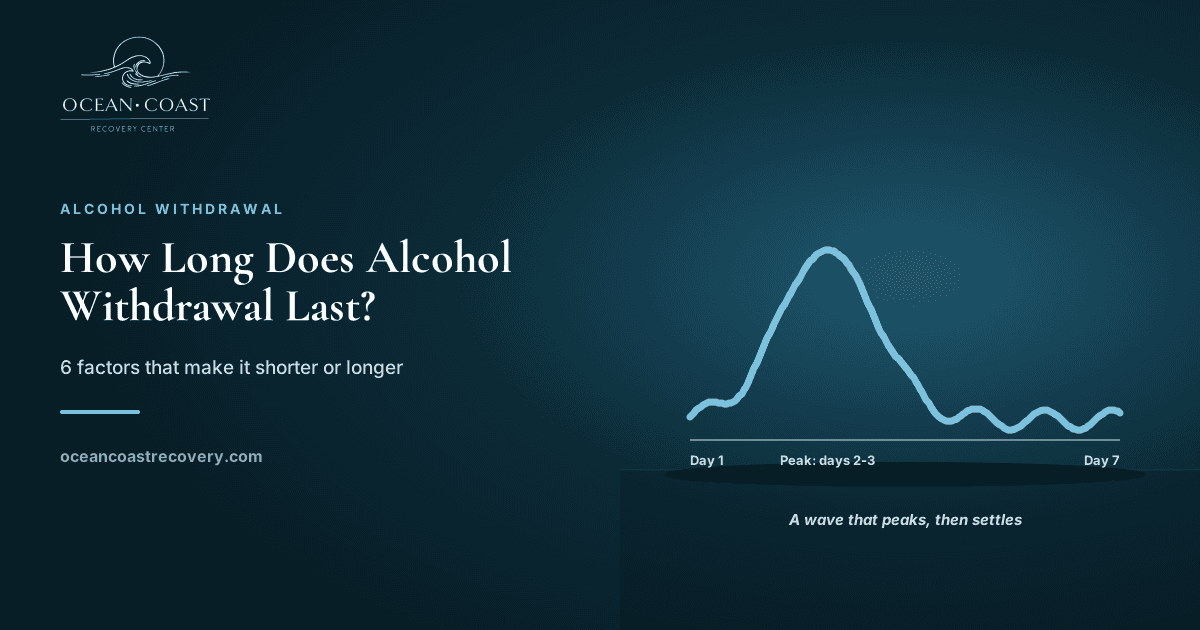
How long does alcohol withdrawal last? For most people, the hardest symptoms start within 6 to 12 hours of the last drink, peak around day 2 or 3, and ease by day 5 to 7.
Six things change that timeline: how much and how long you drank, past withdrawals, physical health, mental health, other substances, and whether you have medical care.
Seizures and delirium tremens can happen. They are medical emergencies.
Sleep trouble, anxiety, and low mood can linger for weeks or months. That is common and it can be treated.
Detox alone is not treatment for alcohol use disorder. It is the first step.
Table of Contents
Warning signs of severe withdrawal: seizures and delirium tremens
How long does alcohol withdrawal last if you quit on your own?
Introduction
You have decided to stop drinking, or someone you love has, and now you are stuck on one question: how long does alcohol withdrawal last, and how bad will it get? It is the right question to ask before the last drink, not after.
The honest answer is a range, not a single number. This article covers the usual timeline, the six factors that stretch or shorten it, the signs that mean you need an emergency room, and what recovery looks like once the first week is behind you.
How long does alcohol withdrawal last? A general timeline
For most people, acute withdrawal runs about 5 to 7 days. Symptoms usually begin 6 to 12 hours after the last drink, get worse over the next one to three days, and then fade. Some people feel normal sooner. Some take longer.
Why does this happen? Long-term drinking changes how the brain balances calming and stimulating signals. When alcohol is suddenly removed, the brain stays stuck in overdrive for a while. The National Institute on Alcohol Abuse and Alcoholism (NIAAA) describes alcohol use disorder as a brain disorder that can be mild, moderate, or severe. The more severe the disorder, the more your body has adapted to alcohol.[1]
Time after last drink | What usually happens |
|---|---|
6 to 12 hours | Shaking, sweating, nausea, anxiety, trouble sleeping |
12 to 48 hours | Symptoms build. Seizures are most likely in this window. |
24 to 72 hours | Peak of withdrawal. Racing heart, high blood pressure, intense anxiety |
48 to 96 hours | Delirium tremens can begin in the most severe cases |
5 to 7 days | Most acute symptoms ease. Fatigue and poor sleep continue. |

Common alcohol withdrawal symptoms by stage
Knowing the stages helps you tell what is expected from what is dangerous. How long alcohol withdrawal lasts matters less than what is happening at each point along the way.
Early (first day): hand tremors, sweating, headache, upset stomach, restlessness, and a strong pull to drink just to feel better.
Peak (days 2 and 3): a fast heartbeat, high blood pressure, fever, intense anxiety, and sometimes seeing or hearing things that are not there.
Settling (days 4 to 7): the physical symptoms fade, but you may feel wrung out, low, and jumpy.
If you are watching someone you love go through this, the peak is the hardest stretch to witness. It is also when a nurse checking vital signs every few hours makes the biggest difference.

6 factors that make withdrawal shorter or longer
Two people can stop drinking on the same day and have very different weeks. These six factors explain most of the gap when you ask how long does alcohol withdrawal last for a particular person.
How much and how long you drank. Years of daily heavy drinking usually mean a longer, rougher withdrawal than a few months of weekend binges.
Past withdrawals. Each time someone goes through withdrawal, the next one can come on harder. Many clinicians call this kindling. A person who has quit and relapsed several times often has a more severe course.
Physical health. Liver disease, poor nutrition, dehydration, and older age can all slow recovery and raise risk.
Mental health. Depression, post-traumatic stress disorder, and ADHD often occur alongside alcohol use disorder.[1] Untreated, they can make anxiety and sleep problems last longer. Our dual diagnosis care treats both at once.
Other substances. Benzodiazepines, opioids, and stimulants complicate the picture. Mixing alcohol with sedating medication is a separate danger, which we cover in our post on Benadryl and alcohol.
Whether you have medical support. Medication and monitoring do not always shorten the calendar, but they make the days far safer and more bearable.

Warning signs of severe withdrawal: seizures and delirium tremens
Alcohol withdrawal can kill. We are not saying that to frighten you, only so you take it seriously. Seizures can strike in the first two days, often with little warning. Delirium tremens (DTs) is a state of severe confusion, fever, and agitation that can start two to four days in.
Call 911 if you or someone you are with has any of these:
A seizure, even a brief one
Confusion, not knowing where they are, or hallucinations
A racing heart with fever or heavy sweating
Vomiting that will not stop
Thoughts of suicide. You can also call or text 988 at any hour.[2]
Do not wait to see if it passes. DTs is treatable in a hospital, and much harder to treat late.

How long does alcohol withdrawal last if you quit on your own?
The calendar is often about the same, but the risk is not. Without monitoring, nobody catches a rising heart rate or a first seizure in time. Many people who try to quit at home also give up on day two or three, drink again to stop the misery, and start the clock over.
If you drink heavily every day, talk to a doctor before you stop. If you cannot reach one, call the SAMHSA National Helpline or use FindTreatment.gov to locate care near you.[2]

Why medical detox is safer than quitting alone
The American Society of Addiction Medicine (ASAM) publishes a clinical guideline on alcohol withdrawal management for both outpatient and inpatient settings.[3] Clinicians use scoring tools to track symptoms, give medication to calm the nervous system, and replace fluids and vitamins such as thiamine. You can read what a typical stay involves in our guide to EtOH detox.
In medical detox, how long alcohol withdrawal lasts becomes a plan instead of a gamble. Staff are there at 3 a.m. when symptoms spike, and someone can step in before a bad night becomes an emergency. Our medical detox program is built around that.
ASAM is also clear on one point: withdrawal management alone is not an effective treatment for alcohol use disorder. It should be the start of treatment, not the whole of it.[3]

Post-acute withdrawal and life after detox
When people ask how long does alcohol withdrawal last, many are really asking when they will feel like themselves again. The acute phase ends in about a week. Then some people hit a second phase, often called post-acute withdrawal: poor sleep, anxiety, irritability, low energy, and trouble concentrating that come and go for weeks or even months.
It is not a sign you are failing. The brain is still recalibrating. Relapse risk is also high during this time. The NIAAA notes that lasting brain changes from alcohol misuse make people vulnerable to relapse, and that behavioral therapy, mutual-support groups, and medications can help people reach and keep recovery.[1]
Keep a regular sleep and wake time, even when sleep is poor.
Eat on a schedule and drink water.
Tell your care team about low mood or panic early.
Stay in therapy and support groups after detox ends.
If you are working and worried about time away, see our post on alcohol rehab for working professionals.
Getting help at Ocean Coast Recovery Center
At Ocean Coast Recovery Center, care usually starts with medical detox, then moves into residential inpatient treatment so the weeks after withdrawal are supported too. Clinicians diagnose and treat alcohol use disorder and co-occurring conditions using the standards in the DSM-5-TR, the classification used by mental health professionals in the United States.[4]
Families are part of this. Our family therapy helps you learn what to expect and how to help without carrying everything alone. When treatment ends, aftercare keeps support in place. Packing for a stay? Start with our first-timer's checklist.
Frequently Asked Questions
Q: How long does alcohol withdrawal last for a heavy drinker?
A: Acute symptoms usually last 5 to 7 days, though a heavy drinker may feel unwell for longer and carries a higher risk of seizures and DTs. Sleep and mood problems can continue for weeks. Heavy daily drinkers should detox with medical supervision.
Q: When do alcohol withdrawal symptoms peak?
A: Most people feel the worst between 24 and 72 hours after the last drink. DTs, when it happens, tends to start a little later, around 48 to 96 hours.
Q: Can alcohol withdrawal be dangerous or life-threatening?
A: Yes. Seizures and delirium tremens can be fatal without treatment. Anyone with a history of withdrawal seizures, long-term heavy drinking, or serious health problems should not stop on their own.
Q: What helps alcohol withdrawal symptoms go away faster?
A: Nothing safely makes withdrawal vanish, but medical care eases it. Medication, fluids, vitamins, rest, and monitoring can reduce symptoms and prevent complications. Home remedies and more alcohol do not help.
Q: Why do some people still feel anxious or sleep poorly weeks after their last drink?
A: The brain takes time to rebalance after long-term drinking. This post-acute phase is common and usually improves. Therapy, steady routines, and treatment for any co-occurring anxiety or depression help.
Conclusion
So, how long does alcohol withdrawal last? About a week for the acute phase, with the peak around days 2 and 3, and a longer tail of sleep and mood trouble for some. Your own answer depends on the six factors above, and the safest way to find out is with a medical team beside you.
If you are asking how long does alcohol withdrawal last because you are ready to stop, call Ocean Coast Recovery Center before you take another step alone. We will tell you plainly what to expect and what the first day looks like.
References
National Institute on Alcohol Abuse and Alcoholism. Understanding Alcohol Use Disorder. https://www.niaaa.nih.gov/alcohols-effects-health/alcohol-use-disorder
Substance Abuse and Mental Health Services Administration. Substance Use Disorder Treatment. https://www.samhsa.gov/substance-use/treatment
American Society of Addiction Medicine. The ASAM Clinical Practice Guideline on Alcohol Withdrawal Management. https://www.asam.org/quality-care/clinical-guidelines/alcohol-withdrawal-management-guideline
American Psychiatric Association. Diagnostic and Statistical Manual of Mental Disorders (DSM-5-TR). https://www.psychiatry.org/psychiatrists/practice/dsm