TL;DR
Call the rehab facility in Orange County before you pack. Rules on phones, medications, and clothing differ from place to place.
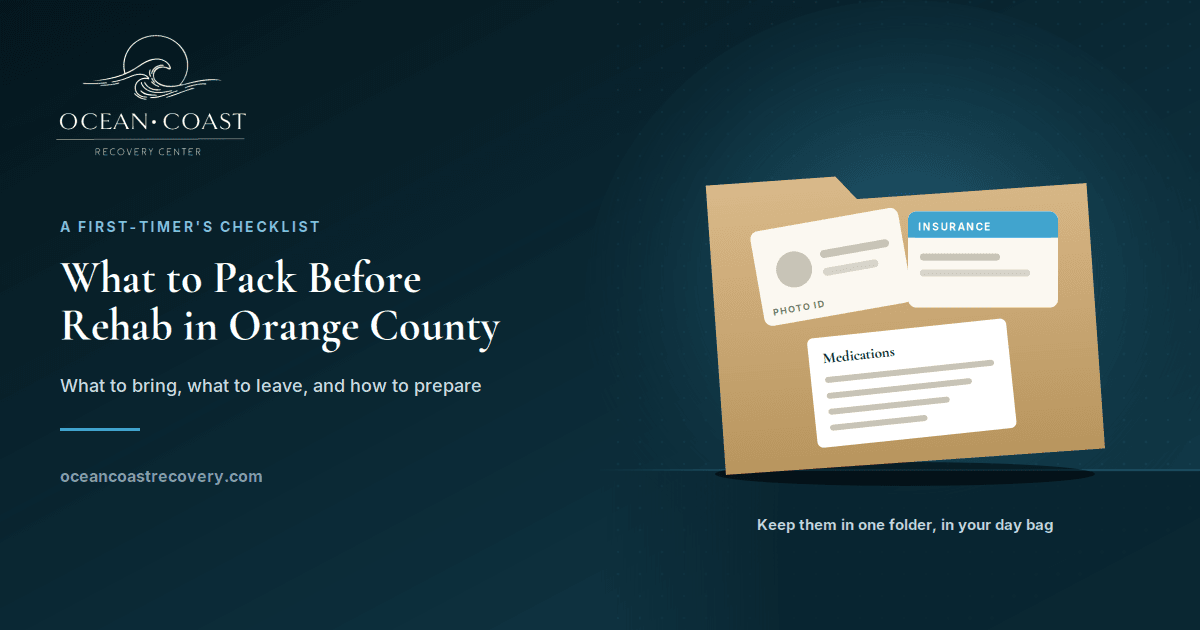
Bring a photo ID, your insurance card, and a written list of every medication and dose. Leave valuables at home.
Pack about a week of comfortable, modest clothing and alcohol-free toiletries.
Settle work, family, money, and pets in advance so you can stop thinking about them once you arrive.
If you are unsure whether you should stop drinking or using on your own first, ask a clinician. Do not quit suddenly without medical advice.
Table of Contents
Before you go: questions to ask your rehab facility in Orange County
Paperwork and practical details: ID, insurance, and medication lists
Preparing your mind: what to expect at admission and during detox
Introduction
Deciding to go is the hard part. Then comes a smaller, oddly stressful question: what do I put in the bag? If you are about to enter a rehab facility in Orange County for the first time, that question can feel bigger than it is, because it stands in for everything else you are afraid of.
This checklist is meant to take that fear down a notch. It covers what to ask, what to carry, what to leave behind, and how to handle the practical parts of life while you are away. If you are a family member helping someone pack, it is written for you too. If you are still choosing a program, our guide to 10 questions to ask before choosing an Orange County rehab program is a better starting point.
Before you go: questions to ask your rehab facility in Orange County
Every program has its own rules, so the first step is a phone call, not a shopping trip. Admissions staff answer these questions all day, and no question is too small.
What is the arrival time, and who meets me at the door?
Is there a written packing list, and does it include a laundry schedule?
Which medications can I bring, and how are they stored?
When can I use my phone, and when can family call or visit?
Do I need to be sober on arrival, or will I start with medical detox?
That last one matters most. If you drink heavily or use opioids or benzodiazepines daily, stopping abruptly can be dangerous. Ask the admissions team whether you should arrive still using so that medical detox can manage withdrawal under supervision. If you want a lower-pressure way to find other licensed programs, SAMHSA runs a national helpline and FindTreatment.gov locator.[1]

Paperwork and practical details: ID, insurance, and medication lists
Put these in one folder or envelope and keep it in your carry-on or day bag, not buried in a suitcase. Staff will ask for them in the first hour.
Item | Why staff need it |
|---|---|
Government photo ID | Confirms identity for admission and medical records |
Insurance card (front and back) | Lets the team verify benefits and authorizations |
Medication list with doses | Prevents dangerous interactions and missed doses |
Prescriber and pharmacy phone numbers | Allows the medical team to confirm prescriptions |
Emergency contacts | Needed for safety and, with your consent, family updates |
Small amount of cash or a debit card | For incidentals, if the program allows it |
Write down every medication, including supplements, over-the-counter products, and anything you take only now and then. People often forget that last category, and it can matter. For example, mixing sedating products with alcohol carries real risk, as we explain in our article on Benadryl and alcohol.
If you take medication for opioid use disorder, such as buprenorphine or methadone, say so on the first call. According to NIDA, these medications are safe, effective, and save lives.[2] The team needs your dose and prescriber to continue it. For coverage questions, see whether drug rehab in Orange County is covered by insurance.

What to pack: clothing, toiletries, and comfort items
Pack light. Most programs offer laundry, so you do not need two weeks of outfits. Seven days of clothes is a reasonable ceiling for a residential stay, though your program's list comes first.
Clothing: 5 to 7 tops, 5 to 7 bottoms, underwear and socks, pajamas, a sweatshirt, and a light jacket. Orange County evenings near the coast can run cool, even in summer.
Footwear: Sneakers, shower shoes, and slippers or comfortable sandals.
Toiletries: Toothbrush, toothpaste, deodorant, shampoo, soap, razors if permitted. Choose alcohol-free versions (more on this below).
Comfort items: A journal and pen, a few photos, a book, and a pillowcase or small blanket if allowed.
Other: Glasses or contacts with solution, a watch, and a list of phone numbers written on paper.
Keep clothing plain. Skip anything with drug or alcohol logos, revealing cuts, or offensive slogans. Label items with your name if you can.

What to leave at home: prohibited items and why they matter
The rules are not about control. A rehab facility in Orange County has to keep every client safe, including people in early withdrawal.
Leave at home | Reason |
|---|---|
Mouthwash, perfume, or hand sanitizer containing alcohol | Can be swallowed or trigger cravings |
Vapes, cigarettes, and nicotine products | Many programs restrict or manage nicotine; ask first |
Unlisted or non-prescribed medications | Staff must account for every substance you take |
Energy drinks and large amounts of caffeine | Can worsen anxiety and sleep problems |
Expensive jewelry and large sums of cash | The program cannot guard your valuables |
Weapons and sharp tools | Safety of everyone in the building |
Staff will usually check bags at admission. This can feel awkward, but it is routine and done with respect. Prescription medications you bring will typically be logged and kept by the nursing team, then given to you at scheduled times.
Phones and laptops are what most people ask about. Policies vary: some programs hold devices for the first days, some allow limited use at set hours. Ask before you pack a charger.

Preparing your life: work, family, finances, and pets
Treatment goes better when the outside world is quiet. A few calls made ahead of time can keep you from worrying about unpaid bills or an unanswered email for the next 30 days.
Work: You do not have to tell your employer the reason in detail. A short statement that you need medical leave is often enough, and HR can explain your options. We cover rights, privacy, and wording in our guide to alcohol rehab in Orange County for working professionals.
Family: Tell one or two trusted people where you are going and how to reach the program. If children are involved, arrange who will pick them up, feed them, and take them to school.
Money: Set up automatic payments for rent or mortgage, utilities, and car payments. Put a trusted person on a short list of tasks, such as collecting mail.
Pets: Line up a friend, relative, or boarding service now. Pet worries are a common reason people delay admission.
Families can also prepare. Many people find the process easier when relatives take part in sessions, and our family therapy program is built for that. Families can also ask what the plan looks like after discharge, since aftercare planning starts early.

Preparing your mind: what to expect at admission and during detox
Admission usually takes a few hours. You will meet a nurse, answer questions about your substance use and health history, give a urine sample, and sign consent forms. A clinician will then recommend a level of care. Programs often use the ASAM Criteria, a set of guidelines from the American Society of Addiction Medicine that matches treatment to each person's needs and any co-occurring conditions.[3]
If you are drinking daily, detox is the first stage. Withdrawal from alcohol can cause tremors, sweating, nausea, and in severe cases seizures, which is why it should be medically supervised. NIAAA lists treatment navigation resources for people seeking care.[4] Our explainer on medical alcohol withdrawal walks through the stages in detail.
Expect to feel tired, emotional, and out of sorts in the first days. That is normal. If you also live with anxiety, depression, or trauma, tell the team at intake. Dual diagnosis care treats both at once. After detox, many clients move into residential inpatient care, where days follow a set schedule of therapy, groups, meals, and rest. If you are weighing a lighter option, read how outpatient rehab works.

Your final day-before checklist
You are not trying to be perfect, only ready enough.
Confirm your arrival time and the address of the rehab facility in Orange County.
Check that your folder holds your ID, insurance card, and medication list.
Remove alcohol-based toiletries and anything on the prohibited list from your bag.
Tell your employer, family, and pet caregiver that you are leaving.
Arrange a ride. Do not drive yourself if you may be impaired.
Eat a real meal and try to sleep.
If you feel scared the night before, that is common. Call the admissions line. Someone will pick up and talk you through it.

Frequently Asked Questions
Q: What should I bring to a rehab facility in Orange County for my first stay?
A: Bring a photo ID, your insurance card, a written medication list, about a week of comfortable clothes, alcohol-free toiletries, and a few comfort items like a journal or photos. Ask your program for its own list, since rules differ.
Q: What items are not allowed at rehab, such as alcohol-based toiletries, vapes, or certain medications?
A: Most programs do not allow alcohol-based mouthwash or perfume, unlisted medications, weapons, or valuables. Vapes and nicotine products are handled differently from one program to the next, so ask in advance. Medications you bring are logged and given out by nursing staff.
Q: Can I bring my phone, laptop, or other electronics to rehab?
A: It depends on the program. Many hold phones during the first days and then allow limited use at set times. Laptops may be restricted. Ask admissions before you pack chargers or devices.
Q: How do I tell my employer and arrange time off before entering treatment?
A: Contact HR and ask about medical leave. You can say you need treatment for a health condition without giving details. Ask the program for a letter confirming your dates if your employer requires one.
Q: Will my insurance cover treatment, and what documents do I need at admission?
A: Many plans cover some level of treatment, but coverage varies. Bring your insurance card and ID, and let the admissions team verify your benefits before you arrive. They can tell you what is covered and what you may owe.
Conclusion
Packing for a rehab facility in Orange County comes down to a short list: your papers, a week of simple clothes, alcohol-free toiletries, and a plan for the people and bills you are leaving behind. The rest is easier once you are inside and supported.
If you are ready to start, or just have a question about the bag, call Ocean Coast Recovery Center. Our admissions team can walk you through what to bring, check your insurance, and tell you what the first day looks like. Visit oceancoastrecovery.com to reach us.
References
Substance Abuse and Mental Health Services Administration. SAMHSA Home: National Helpline and FindTreatment.gov. - https://www.samhsa.gov
National Institute on Drug Abuse. NIDA: Medications for Opioid Use Disorder and Treatment Resources. - https://nida.nih.gov
American Society of Addiction Medicine. ASAM Criteria, 4th Edition. - https://www.asam.org
National Institute on Alcohol Abuse and Alcoholism. NIAAA: Alcohol Treatment Navigator and Alcohol Use Disorder Resources. - https://www.niaaa.nih.gov